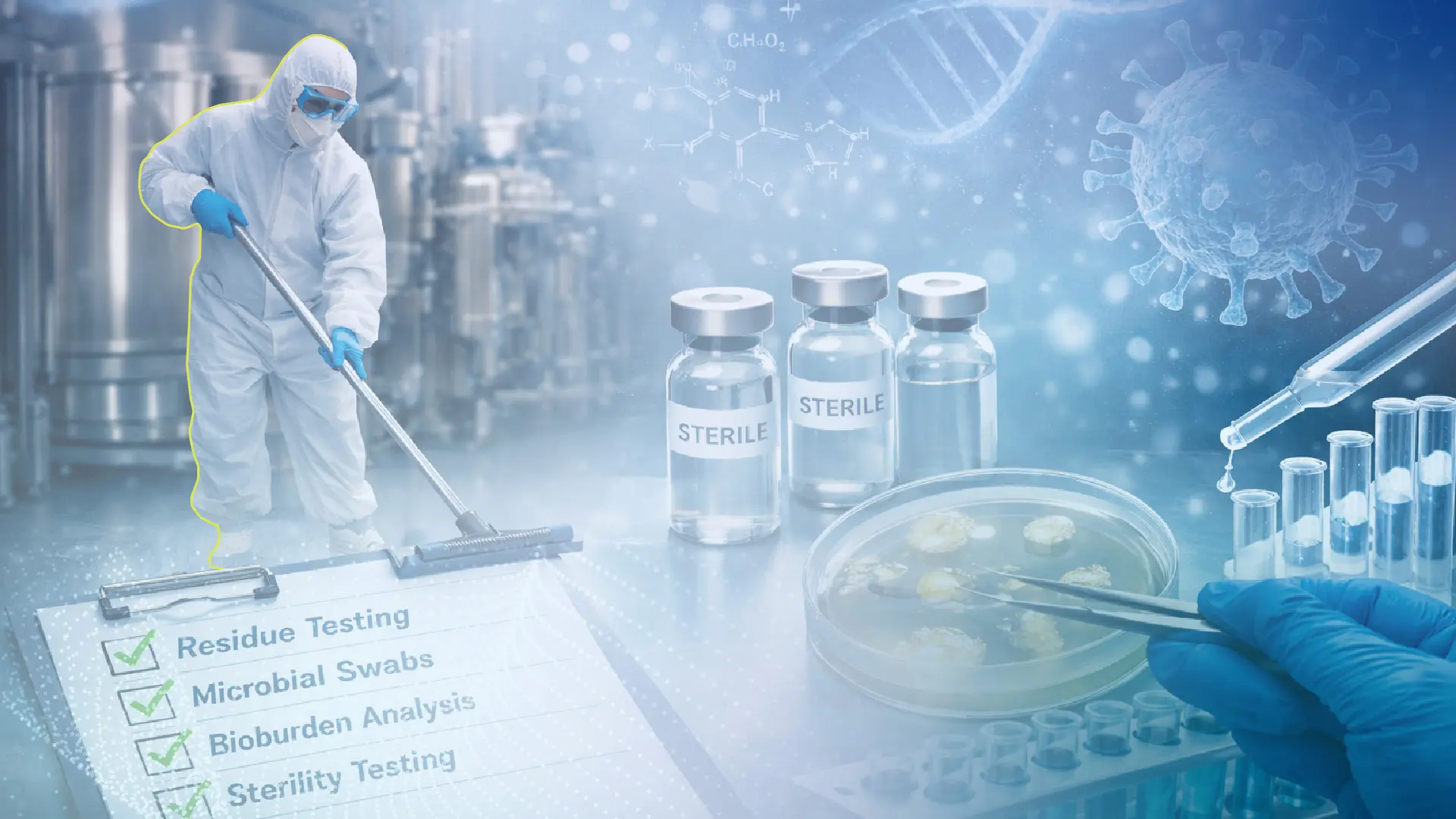
3rd Annual Cleaning Validation Summit 2026

Cleaning Validation
Event Details

Conference Overview

From Fundamentals to Lifecycle Control in a High-Scrutiny Environment

Join us for the 3rd Annual Cleaning Validation Summit, a two-day virtual event dedicated to the latest regulatory
expectations, best practices and real-world challenges in pharmaceutical cleaning validation. Building on the success
of the 2025 edition, the 2026 summit reflects how the industry has evolved in response to increased regulatory scrutiny,
Annex 1 implementation, digital transformation and more complex product portfolios.

Day 1 reinforces core principles and regulatory alignment, incorporating inspection trends observed in 2025.

Day 2 focuses on advanced lifecycle management, risk-based decision-making, automation and complex case studies,
supporting sustainable, inspection-ready cleaning validation programs.

We Will Talk About

  • Cleaning Validation Lifecycle Approach
  • Analytical & Microbiological Methods for Cleaning Validation
  • Visual Inspection as a Contamination Control Tool
  • Cleaning Validation Documents, including Protocols and Inspection-Readiness
  • Product and Equipment Grouping
  • Regulatory & Inspections Trends Update
  • Cleaning process development and cleaning agent selection
  • Limit setting and visual clean – how does this fit together?
  • Risk-Based Cleaning Validation in Complex Facilities
  • Process Analytical Technology (PAT) in Cleaning Validation
  • Degradation of therapeutic proteins during cleaning: Implications for setting acceptance limits for cleaning validation
  • Extending Visible Residue Limits to Potent Therapeutic Proteins: Replacing TOC Swab Testing with a Scientifically Justified Visual Approach

Who Is It For?

The event covers key areas of product quality, regulatory compliance and manufacturing processes. The following departments would benefit from the insights shared at the conference:

● Cleaning Validation/ Containment)
● Bioprocessing/ Bioproduction
● Aseptic Processing
● Sterility Assurance
● Manufacturing Science & Technology
● Good Manufacturing Practice (GMP)
● Cleaning Products/ Detergents
● Risk Management
● Quality Assurance
● Quality Control
● Analytical Development
● Regulatory Affairs

Agenda 3rd Annual Cleaning Validation Summit 2026

Download the full summit program to find speaker biographies, case studies, key takeaways, the day's schedule, and details of each session.

Speaking Companies

Previous Events
2nd Annual Cleaning Validation Summit 2025
October 1, 2025
A premier two-day event dedicated to best practices, regulatory expectations and emerging trends in pharma cleaning validation. [Recording: 16 video sessions].
Expired
[•REC] - €345
Cleaning Validation Summit
October 1, 2024
Looking to build compliant cleaning validation program and ensure that your next product is not affected by contamination? [Recording: 14 video sessions].
Expired
[•REC] - €295

Speaker Board
Rizwan Sharnez
President
Cleaning Validation Solutions
Antoinette Ryan
Vice President Quality Assurance
Controlled Contamination Services
Susan Malkin
Vice President
Global Financial Institution
Ester Lovsin Barle
Global Head PSS
Takeda
Michael Moussourakis
Vice President of Strategy
Alconox, LLC
Joe Cagnassola
Sr Tech Transfer Leader
Fresenius Kabi, LLC
Ram Kouda
Scientific Associate Director
Amgen
Liz Dallison
Analytical Chemist
Pfizer (Retired)
Jenna Carlson
President & Quality Consultant
Mindful Quality
Brian Bosso
Technical Service Manager
STERIS
Andrew Walsh
President
CPCI™
Mariann Neverovitch
Sr. Manager Logistics Operations
Bristol-Myers Squibb
Fred Ohsiek
Associate Director of Cleaning Validation
Eliquent Life Sciences
Thomas Altmann
Global Technical Consultant
Ecolab Deutschland GmbH

Summit Agenda

◆  Analytical techniques (HPLC, TOC, UV-Vis) and rapid methods.

◆  Validation of analytical methods.

◆  Recovery studies.

◆  Microbiological testing.

◆  Clarifying two safety paradigms: Explain how PDE and OELs are derived.

◆  Understanding why limits diverge: Highlight how differences can lead to large PDE–OEL mismatches.

◆  Equipping experts for inspections: Provide inspection-ready guidance on articulating the scientific rationale behind both limit types.

◆  Minimum regulatory expected cleaning validation documents.

◆  Essential elements of modern cleaning validation protocol.

◆  Aligning acceptance criteria with toxicology and analytical capability.

◆  Common documentation gaps identified during inspections.

◆  Quick review of regulatory expectations.

◆  Spray coverage equipment grouping.

◆  Product bracketing.

◆  Equipment grouping.

◆  Equipment grouping case study.

◆  FDA, EMA and PIC/S expectations for cleaning validation in 2026.

◆  Key inspection observations and deficiencies seen in 2025.

◆  How to proactively address recurring regulatory findings.

A review of general cleaning gen¬eral cleaning concepts, chemistry, and detergency. Aqueous detergent cleaning will be reviewed with a detailed focus on automated CIP (Clean-In-Place) cleaning methods, associated pros and cons, and the nature of such detergents. The types of surfactants, and related chemistries being used. The necessary pre and post cleaning steps, vital to any cleaning application are presented as a lifestyle ap¬proach. Their goal being to facilitate cleaning validation programs. This includes needs for focus on set up and procedures before cleaning steps are introduced, during the cleaning process itself, and methods for good prac¬tice in post cleaning—long after the final rinse has been completed. Finally, a recent automated cleaning validation of a dermatological product is presented as a case study and reviewed. The requirements, results and procedure followed. The residue detection methods chosen for both residual product and detergent will be discussed.

◆  What is ASTM E3263.

◆  EMA requirements for justifying Visual Inspection.

◆  Selection of Products and Materials of Construction for Visual Inspection studies.

◆  Using Attribute Agreement Analysis for Qualification.

◆  Automation of Qualification using Cell Phone APP.

◆  Visual inspection following equipment cleaning is a mandatory step in the cleaning verification workflow for pharmaceutical equipment. Equipment must pass visual inspection before swab sampling for analysis can be performed.

◆  Since a significant number of low-risk compounds are visible well below established safety levels, it is possible to justify equipment as “visually clean” without performing swabbing analysis. Internal studies performed at BMS showed that over 90% of participants could identify residual product at a level of ~2 ppm without preliminary training.

◆  The implementation of a robust visual inspection qualification program and clear “Visually Clean” inspection parameters can enable visual inspection to be used to qualify equipment in lieu of swab analysis for low-risk products.

◆  Regulatory expectations.

◆  Laboratory bench scale studies / cleanability trials.

◆  Implementation of cleaning process on-site.

◆  Levels of cleaning and level of documentation requiered.

◆  Limit calculation for cleaning validation (HBEL, fixed limits, TTC).

◆  Points to consider for limit setting.

◆  Visual clean - regulatory requirements.

◆  Determination of visual residues limit (VRL).

◆  Case study Paracetamol and visual clean.

◆  Applying FMEA and other risk assessment tools.

◆  Risk ranking, control strategies and justification.

◆  Managing shared equipment and multiproduct facilities.

◆  Case study: defending risk-based decisions during inspections.

◆  Real-time monitoring techniques.

◆  Analytical methods in PAT for in-line, on-line and at-line testing.

◆  Bridging lab scale and full-scale testing.

◆  Case Studies for PAT in Cleaning Validation.

◆  Why the human factor matters.

◆  Training does not equal competency.

◆  Behavioral Drift.

◆  Engineering controls.

◆  Annex 1 tie-in.

◆  Chemistry of protein degradation.

◆  Regulatory expectations.

◆  Bench-scale degradation studies.

◆  Current trends and challenges.

◆  Acceptable exposure of inactive protein fragments.

◆  Leveraging degradation to set achievable acceptance limits.

◆  Assessed whether VRL-based visual inspection can replace TOC swab testing for protein cleaning validation.

◆  Tested mAbs, fusion proteins, and BiTEs under controlled worst-case viewing conditions.

◆  Native vs Degraded protein Visual residue limit assessment.

◆  Demonstrated VRLs translate to TOC values within current acceptance limits, supporting VRL as a viable alternative.

Amgen, USA

◆  Overview of computer vision models.

◆  How to build a model for cleaning validation.

◆  How computer vision models can help with cleaning validation.

Registration Tickets

15% discount for 1 person registered, 20% discount per person if 2-3 bookings, and 25% discount per person if 4+,. The discount is valid until 1st of May 2026

To receive a discount coupon, email us at info@uventia.com or submit a REQUEST BROCHURE.

most popular
2 Days Ticket + Recording
595

Full access to the 2 days online event.

Recording of 2 days event sessions.

Digital certificate of attendance.

List of participants.

PDF presentations.

1 Day Ticket + Recording
415

Full access to the 1 day online event.

Recording of 1 day event sessions.

Digital certificate of attendance.

List of participants.

PDF presentations.

2 Days Recording
495

Recording of 2 days event sessions.

Digital certificate of attendance.

List of participants.

PDF presentations.

To register to the summit as a Delegate, complete the registration form. After submission, you will receive confirmation and invoice. Registration for the virtual event covers access to all online material in the Proceedings including keynotes, PDF presentations and papers, posters, and delegate list with contacts as well as video recordings of speakers' speeches.

If you need more information, please contact us at info@uventia.com

Event Details
Sponsors